



Markets have an irritating habit of making fools of those searching for perfect historical analogies. The Japanese yen has certainly played that role more than once over the past forty years.
Every generation of traders seems to discover, usually the hard way, that USD/JPY is capable of moving far further than seems remotely sensible before Tokyo finally reaches for the emergency brake. The latest episode is no different.
For much of the post-COVID period, the dollar has marched relentlessly higher against the yen, powered by one of the widest interest rate differentials in modern history. The Ministry of Finance has stepped into the market before most notably during July 2024 around the now familiar 160 area but the underlying trend eventually reasserted itself.
That naturally raises the question. If intervention only buys time, why intervene at all?
The answer, Speculators Edge reckon, tells us considerably more than the intervention itself.
History suggests there are broadly 3 reasons governments choose to enter the foreign exchange market.
The first is that policymakers genuinely believe a macroeconomic turning point is already forming beneath the surface.
The second is that they recognise the market has become spectacularly one-sided and simply need a catalyst to accelerate an adjustment that was likely to happen anyway.
The third and perhaps the least interesting is that officials merely wish to slow an overshoot without believing the broader trend has fundamentally changed.
The first 2 tend to be the occasions worth paying attention to.
After all, coordinated intervention is not something governments undertake because they have run out of hobbies for the weekend. It consumes political capital, requires coordination between institutions that rarely agree on lunch, let alone exchange rates, and carries an obvious reputational cost should markets simply steamroller straight through it.
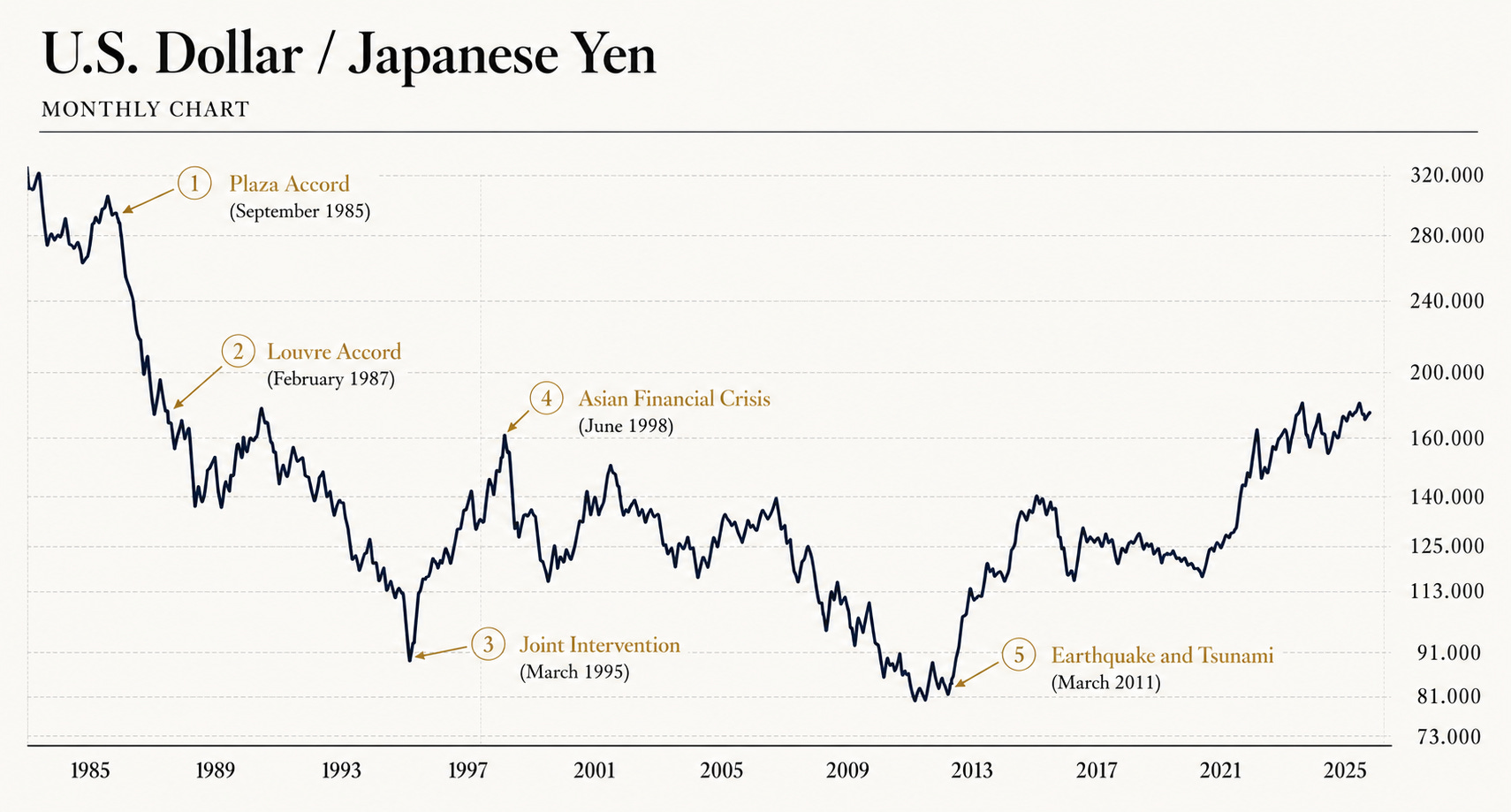
Which brings us neatly to 1995.
Contrary to popular memory, intervention did not magically reverse USD/JPY.
The macroeconomic landscape did, as it was ripe.
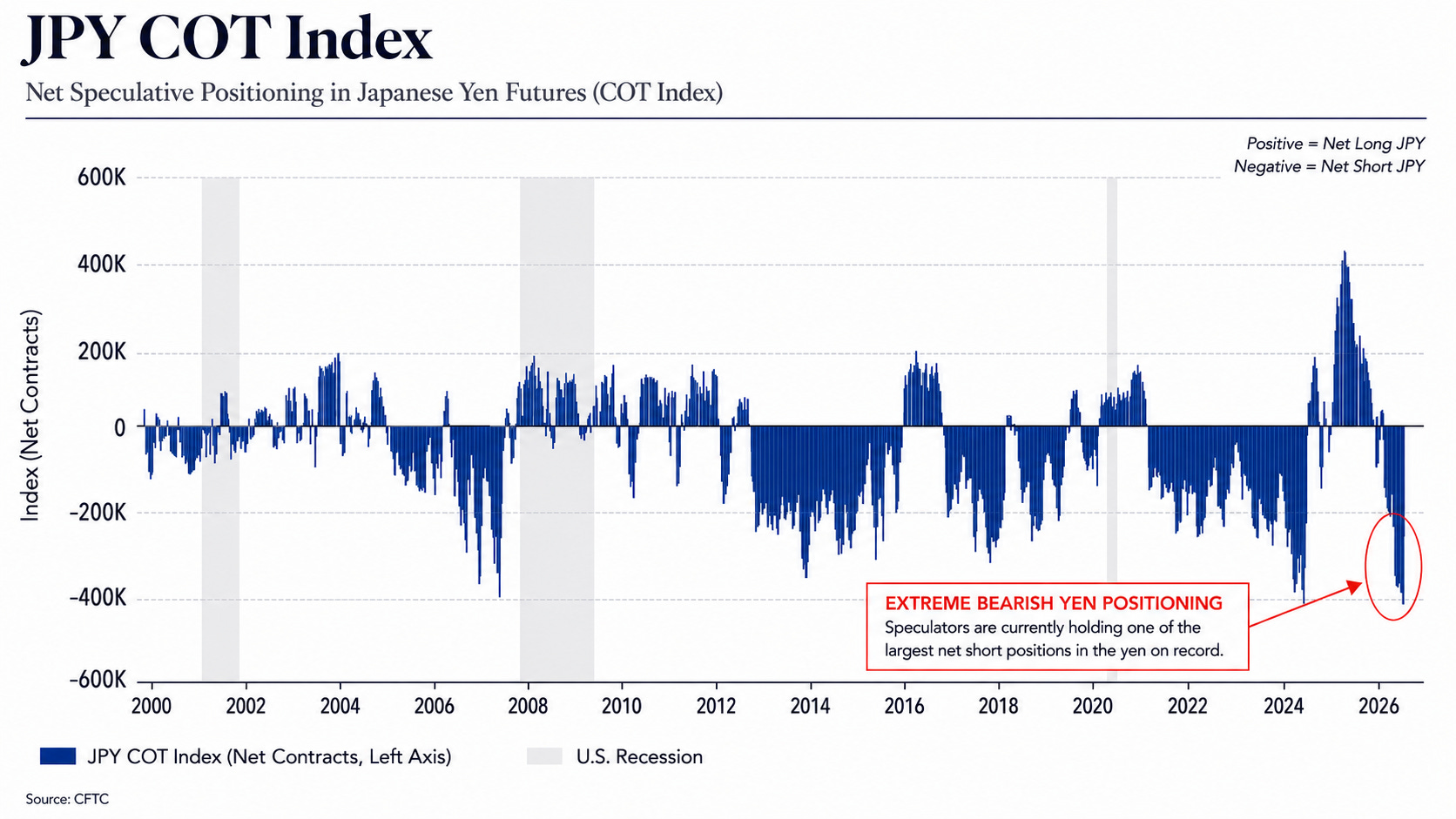
The United States was emerging into stronger growth, Japan was easing policy, speculative positioning had become remarkably stretched (just like it is now) and, by most valuation measures, the dollar had become historically cheap against the yen. Intervention merely provided investors with permission to act on a story that macro fundamentals were already signalling.
The market eventually followed.
Something remarkably similar occurred during the Asian Financial Crisis.
Initially the intervention looked almost futile. USD/JPY fell sharply, rebounded, chopped around for several weeks and appeared to settle back into its previous habits. But while price looked directionless, macro trader’s psychology was changing.
Investors slowly realised that both Washington and Tokyo were standing against further dollar strength. That altered positioning and future decision making.
Then came Russia’s default, LTCM collapsed, global risk appetite evaporated, carry trades unwound and macro events supplied precisely the catalyst policymakers had almost certainly hoped would arrive. History did not repeat but it rhymed.
The 2011 intervention followed much the same script, albeit different direction.
Initially the move faded. USD/JPY drifted back towards intervention levels, leading plenty of commentators to declare the operation ineffective.
Then the regime changed.
The Federal Reserve embarked on aggressive hiking cycle while the Bank of Japan remained committed to extraordinary easing. One of the largest monetary divergences of the modern era followed, carrying USD/JPY substantially higher for years afterwards.
Again, intervention did not create the trend. It arrived just before the macro tide began flowing in the same direction.
That distinction matters enormously today.
Speculators Edge are less interested in whether intervention succeeds over the next fortnight than whether policymakers are recognising a broader shift already underway.
Several ingredients appear to be falling into place.
The Federal Reserve is poised to hike again but Kevin Warsh was hand picked to cut rates by the president. If the Fed is steadily moving closer towards another easing cycle. The Bank of Japan continues, however cautiously, to normalise policy after decades of extraordinary accommodation. Yield differentials which have explained so much of USD/JPY over recent years look increasingly vulnerable to narrowing rather than widening. That alone is worth several thousand pips lower in the exchange rate.
Meanwhile speculative positioning remains heavily skewed, meaning any shift in macro expectations risks producing an outsized adjustment as investors scramble through the same rather narrow exit door.
YEN POSITIONING
None of this guarantees a major reversal.
Officials can intervene simply because volatility has become politically intolerable. They may merely wish to smooth the journey rather than change the destination.
But history offers an intriguing observation.
The rare occasions when Washington and Tokyo have chosen to expend political capital together have generally coincided with much larger macro forces waiting just over the horizon.
Therefore intervention did not cause those forces, but it has an uncanny way of arriving just in time, all the time.
Which leaves us with what may be the most interesting possibility of all.Perhaps the recent intervention was never really about defending 160.
Perhaps it was about getting in front of a macro regime shift that policymakers suspect is already beginning.
If that proves correct, the next chapter is unlikely to resemble a violent collapse. Markets rarely grant such generosity. Far more likely is a frustrating period of chop, false starts and tactical rallies before the larger trend gradually exerts itself.
The yen has, after all, spent 40 years reminding traders that turning points are processes rather than events.
It would be entirely in character if it chose to do so again.
Governments don’t intervene because they think they can beat markets. They intervene because they increasingly believe macro forces are about to fight on their side.
TRADE STRONG
MIAD
Good read txs.