



Before you read another word, I want you to do something. Get a pen, open a notes app, or just hold the answers in your head but actually answer. The piece works if you do it. It does nothing for you if you skip it.
Here are six scenarios. For each one, write down two things: what you would feel, and what you would do.
1. You are up 28% on the year after a strong three week run. A stock you have been watching gaps up 18% pre market on hype. You have no position. The market opens and it keeps running.
2. You are in a normal sized position. Unexpected news hits and the trade is now down 12% in a single day. It is your biggest one day loss in months. You still believe the thesis.
3. You passed on a setup. It is now up 45% in two days. Your feed is full of screenshots. You have cash sitting idle.
4. You took three small losses today, total minus 4%. You are sitting in front of the screen, frustrated. A new setup appears. It is marginal at best.
5. You just closed your best trade ever, plus 42% in four days. You feel unstoppable. You spot two new ideas that are riskier than your normal rules allow.
6. Range bound, choppy market for three weeks. Your edge setups are not appearing. You have been in cash, watching.
Done? Good. Hold those answers. We are going to come back to them.
The trade you got right that lost you money
Picture this. EURUSD, clean resistance, a plan you have run a hundred times. Price breaks up, fails, rolls over. You short the retest. The execution is textbook. The trade dips into profit, stalls, reverses, takes you out at the stop. Then price drives directly to your original target, untouched.
You were right. You were stopped out. Both true.
This is the most dangerous moment in your trading month, and the loss itself is the smaller part of why. The bigger part is the combination of being correct and being punished. The market did not just beat you. It slapped you, swept your legs, and proved your thesis was right the entire time. That double humiliation is the seed of account destruction, and most traders do not see it coming because they think the danger has passed once the trade is closed.
Here is what almost nobody connects: the revenge trade does not always fire ten minutes later. Sometimes it incubates for a month. Four weeks after the EURUSD stop out, you take a reckless oversized entry on something unrelated, and you never trace it back to the original event. But that is where it began. The body remembers.
So we have a problem. The market periodically humiliates competent traders. Willpower does not solve it. Affirmations do not solve it. What does solve it is architecture.
Humiliation as architecture

Look at scenario 4 again. Three losses on the day, frustrated, marginal setup. Most traders take it. The trade is not really about the trade it is about discharging the energy. They need a win to feel okay again. The setup is just the excuse.
Here is the version a process trader runs through that scenario. Three losses on the same day is statistically rare for me, so the first question is not what to do next, it is what just happened. Was it me, or was it the market? Did I cross trade unrelated assets and catch random feedback? Has the regime shifted? The next setup will need to pass through heavier filters, not lighter ones. And if it is marginal, I do not take it. I sit it out, and I sit happily.
That is the answer. But notice what is doing the work. The work is not discipline summoned in the moment. The work is a process that lives upstream of the moment.
Now take that same logic and weaponise it. The anti revenge pattern is built directly from the trade that got you stopped. On the EURUSD trade using Asia range strategy, the rule that emerged from journaled data is this:
If your stop loss gets hit twice on the same day within the same setup, and a third signal prints on that same day, the probability of the third signal working exceeds 90%. Risk to reward routinely runs above 3R, sometimes 5R, occasionally 10R.
Read that again. The trade that humiliated you is the trade that pays you. You are not suppressing the humiliation. You are redirecting it into a catalogued, data backed pattern. The same instinct that produces revenge trades produces the anti revenge trade. Same energy. Opposite consequence.
This is what I mean when I say humiliation is architecture. The body wants to respond. Give it somewhere to go.
Why most traders never see the signal
Stay with me, because the next part decides everything.
The front of your brain receives a heavily filtered stream of information. It distils roughly a billion data points down to a small handful of bits your conscious mind can process. That is the part you are aware of. The part you talk to yourself with.
The back of your brain has a different input stream. Smell, taste, vision, temperature, heart rate, perspiration, gut. That information lands in a region called the anterior insula. The two regions sit inside the same skull and cannot speak directly. Their only translator is the body.
A faint tingle in the hand. A small pressure in the chest. A sinking feeling in the neck. Most traders dismiss these as noise. They are not noise. They are the anterior insula firing an engram activation, recognising a pattern it has seen before, asking the prefrontal cortex to do something about it. Unless you map these sensations deliberately, you will go a full career without registering them.
This matters because in 2026, raw cognition is a commodity. AI flattened the cognitive playing field. You are now just as smart as nearly anyone else with a screen and a chat box. The strategies are public. The frameworks are public. So where does the edge live? It lives in the one place AI cannot enter, which is the body.
Across a 147 trader sample I have worked with, those who applied a structured three to twelve week body mapping protocol showed payouts roughly 50% higher than those who did not. Two distinct sensation clusters emerge over time. One precedes good trades. One precedes bad ones. Once you can identify your own clusters, you have something no book can sell you, no course can transfer, and no model can replicate. It is internal data, generated only by you, available only to you.
Now go back to scenario 2. Down 12% on a single trade, biggest loss in months, thesis intact. The instinct is to hold. To let hope do the work. The process trader runs a different sequence: map every scenario from here, and in every outcome where the long term play is to close, close now. Not because the loss feels bearable.
Because how you do one thing is how you do everything. If you hold and the trade rolls back into the money, you have just rewarded a bad behaviour with a good outcome, and you are in real trouble. The rest of the year you will hold losers because once it worked.
A process trader closes in that moment because the body has been mapped. The sensation that arrives with hope is recognisable, and recognisable means dismissable. There is no stoicism involved. The work happened months earlier.
What conviction actually is

Scenario 5. Best trade ever, plus 42%, feeling unstoppable, two new ideas outside the rules.
The feeling of unstoppable is the signal. Not the setups. The first move is to address the state, not the trade. Grounding, time lag, distance between the emotion and the next decision. The setup is not just a read on price, it is a read on your risk environment regardless of what you achieved up to this point. If the trade is riskier than your rules allow, you do not have an edge. You have a feeling. You sit it out.
This is where most traders get conviction wrong. They confuse a lucrative target for a high probability trade. A big payout is not the same as a high probability outcome. The two are often inversely correlated. Real conviction comes from one of two places, and only these two:
Mathematical pattern data. A catalogued setup with a robust historical hit rate. The NASDAQ two week inside bar is the textbook case. Across roughly 13 to 14 documented instances, a specific failure pattern, where the inside bar breaks out and then violently swings back into range, had never failed to carry price to the opposite side. Layered with standard risk controls, that translates into roughly an 80 to 85% probability trade. That is conviction.
Honed internal pattern recognition. Engrams built from years of repetition. The May Bitcoin buy was the case study. Around the tariff wars, equities were tanking, Bitcoin held, liquidity was strong beneath it. The red candle was terrifying. The engrams said buy. Near 90% conviction, internal pattern recognition in the highest percentile.
Even then, sizing decides whether conviction earns you anything. The rule, taught to me by a French family office mentor running multi million euro accounts: 90% of the account is base capital, never touched, sitting as margin and ballast. 10% is trading capital. Oversizing on a high conviction trade is funded only by floating profits or realised profits already banked from the regime, never by the base 10%. On the May Bitcoin trade, with roughly 50K of floating profits already on a trending position, up to 40K could be risked on the new entry. If it failed, a small dip. If it worked, fresh floating profits funding the next entry. That is how scale compounds without blow up risk.
Same framework applied to gold last year, silver in January, GBPJPY recently. GBPJPY did not work. The damage was a minute dip. Because the sizing was right.
The two scenarios you probably handled worst
Scenarios 1, 3, and 6. The lottery, the missed move, the dead market.
These are the scenarios where most traders bleed without realising they are bleeding. Nothing dramatic. No blow up. Just a slow drip of low quality decisions made because doing nothing feels like failure.
Scenario 1, the gap up on hype. The honest read is you have no edge here. The first emotion is FOMO, and the FOMO is the alert. If you are feeling it, many others are too, and that is exactly what makes it a trap. The process is JOMO, joy of missing out, and you sit.
Scenario 3, the missed 45% move with cash idle. Frustration is the correct emotion. Let it run its course while you do nothing. Missing the move is a double punishment because you also have to nurse the wound of having missed it, and that is when traders take low quality setups to medicate the regret. Have a process for it before it happens, not during.
Scenario 6, the choppy three week range. This is where overtrading is born. Two triggers, both psychological. The first is uncertainty intolerance. Trading is solitary, no one is whispering not to take this trade, and the body refuses to sit. The second is drawdown panic. Time pressure compounds, the trader fixates on what they could still have if they had done nothing, and the curve accelerates lower.
The fix in all three is the same, and it is structural rather than emotional. Restrict the menu. Walk into a restaurant and you get four sections: starter, main, dessert, drinks. The disciplined trader’s menu is more austere than that. A handful of catalogued setups, each with a documented hit rate, each with a defined entry, exit, and invalidation. Anything outside the menu is not a trade. It is an impulse wearing the clothing of a trade.
This sits inside a broader expected value framework. Every decision passes through four checks: execution, risk, edge, psychology. If any of the four fails, you do not take it. You are never forced to trade. You are only ever obliged to wait for the conditions where your edge meets the right regime, and your psychology is calibrated to execute it cleanly.
The honest part
Now go back to your six answers.
Where did you describe a process and where did you describe a feeling? Where did your answer assume you would override yourself in the moment, and where did your answer describe something you do upstream of the moment? Where did you say you would close, and where did you reach for hope?
The gap between your answers and the answers in this piece does not measure intelligence. It measures how much process work you have done. That gap closes through reps. Mapping the body. Cataloguing the setups. Writing the rules for the moment when you are not yourself, so that the rules can be in the room when you cannot be.
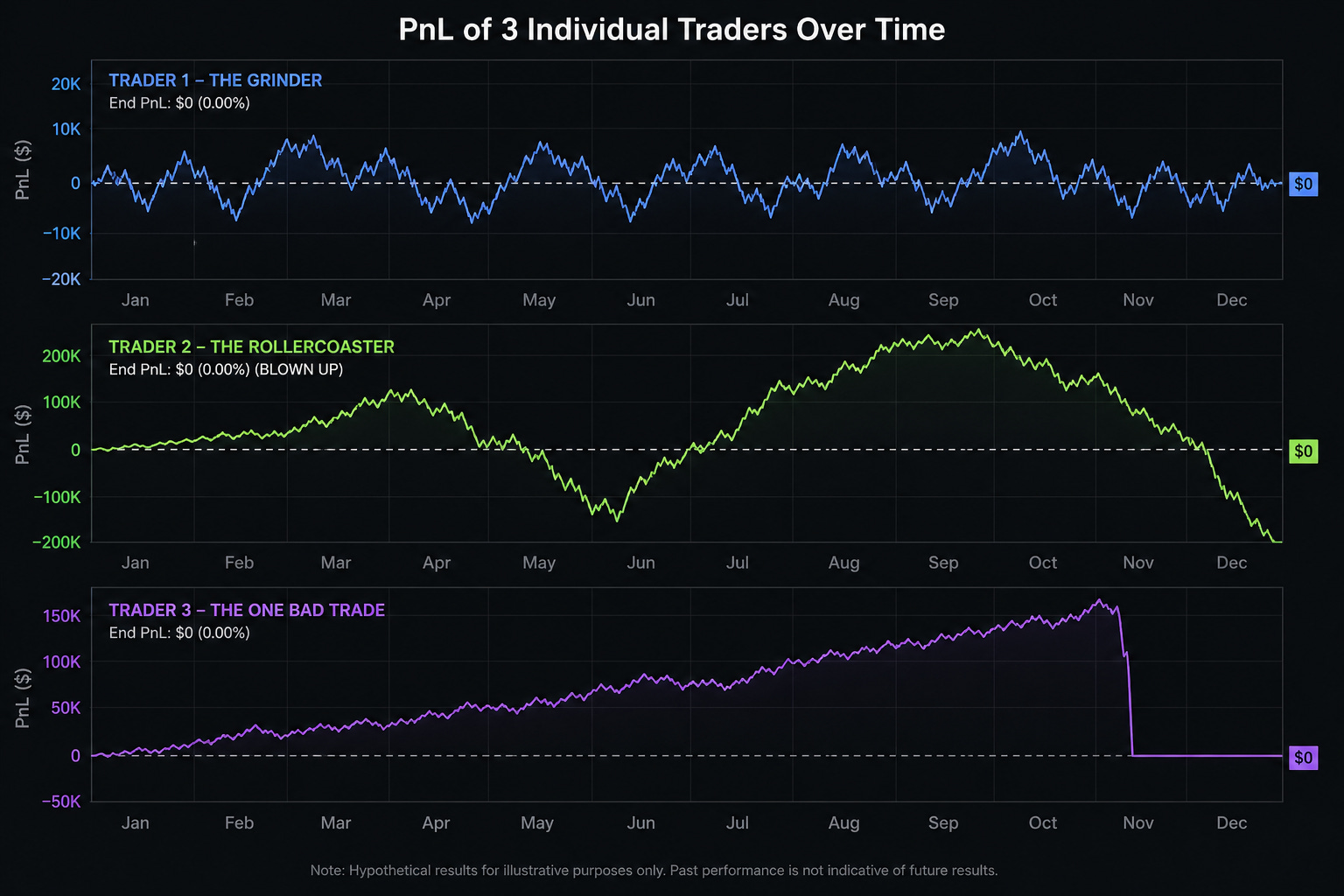
Three traders, three different emotional journeys, identical destination at zero. One grinds sideways. One surges, blows up, surges, blows up. One looks healthy until a single oversized trade in the wrong regime takes everything back. Different stories. Same chart. The line between starting capital and ending capital is flat or down. Your next high must exceed your last high, or something in the process has broken and needs isolating.
The market will humiliate you. The question is whether the humiliation goes into a rage click or into the third signal of the day at double size on a 90% probability setup. Both come from the same place. Only one of them compounds.
I hope this piece will be the start of a journey towards a better tarder, the best tradr you can be and beyond.
Trade Strong
Miad