
Executive Summary
The global landscape is currently undergoing a structural transformation of unprecedented scale, driven by the geometric expansion of artificial intelligence and the resulting demand for massive, high-density compute capacity111. This isn’t just a technological shift; it is a fundamental reconfiguration of how the world’s most powerful corporations finance their growth and power their operations. As hyperscale giants like Meta Platforms, Microsoft, Amazon, and Oracle accelerate their capital expenditure to support the generative AI revolution, we are witnessing a pivot from self-funded, balance-sheet-intensive construction to a sophisticated financial architecture centered on Special Purpose Vehicles (SPVs).
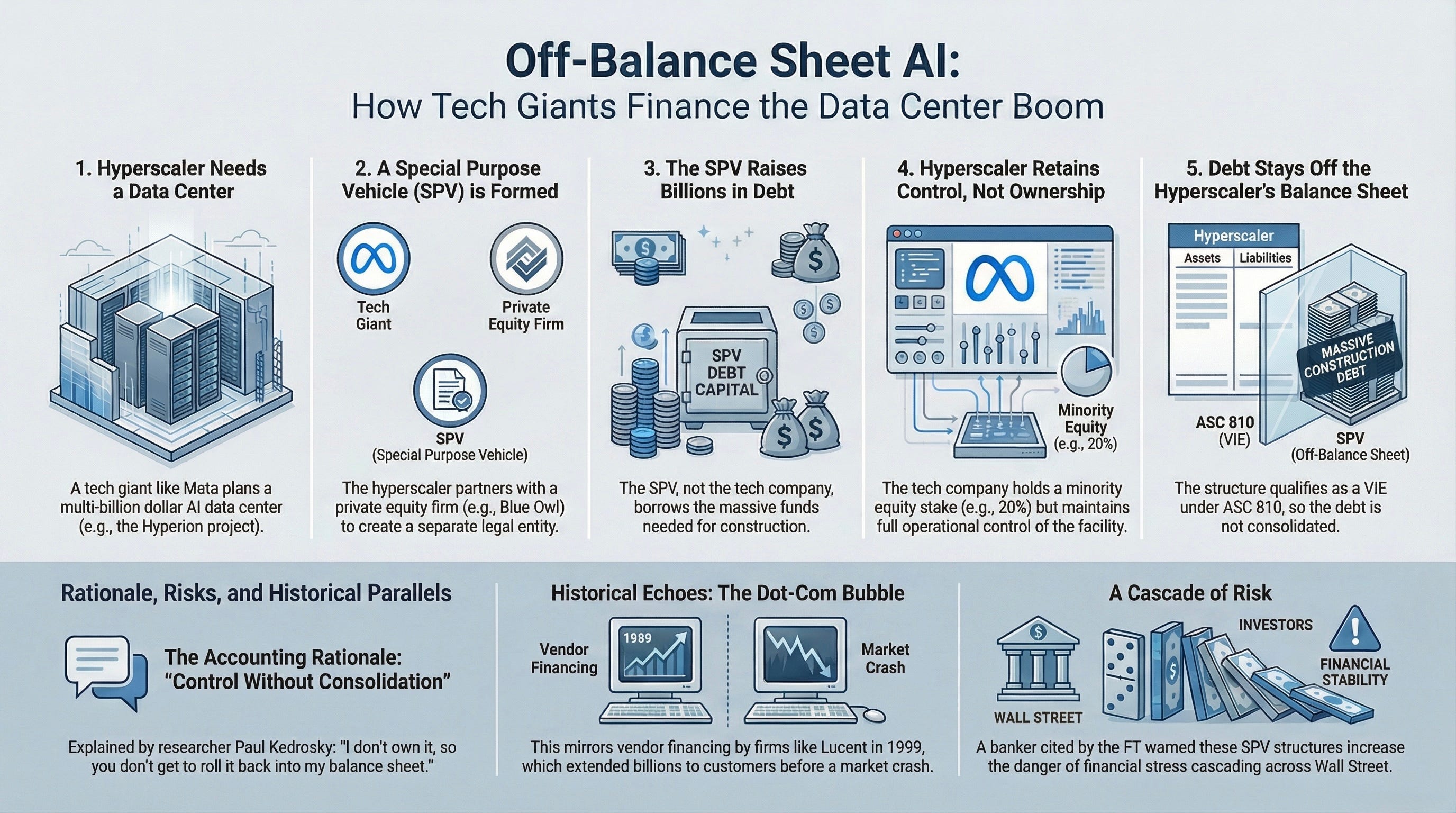
This “Hyperscale Gambit” is defined by a strategy of “control without consolidation,” allowing these firms to execute multi-billion-dollar infrastructure projects while keeping the associated debt off their primary financial statements. In 2025 alone, we have seen over $120 billion in such off-balance-sheet debt moves. However, this rapid buildout has collided with the physical limitations of the legacy electrical grid, particularly in regions like the PJM Interconnection, where data centers are projected to account for 94% of all load growth through 2030.
What does this mean for your portfolio? The market is currently grappling with a profound timeline mismatch: long-term debt (20–30 years) is being used to fund assets like GPUs that have a practical useful life of only 2–3 years. We are seeing a 57% vertical rally in the NASDAQ that is entering the end of a critical window (150–190 days), drawing striking parallels to the post-COVID vertical rally of 160 days which ended in a 15% correction, and the 2018 recovery of 126 days which saw an 11% pullback.
In this deep dive, we break down the three dominant “schools of thought” currently fighting for the future of AI: the high-leverage Hyperscale Gambit, the decentralized Climate-Aligned Buildout, and the skeptics’ Cautious Path. From the $30 billion Meta Hyperion deal to the resurgence of nuclear power at Three Mile Island, this post exhaustively details every major catalyst, financial risk, and trade setup you need to navigate this cycle.
The Hyperscale Gambit: Financial Engineering at Maximum Velocity
The dominant paradigm in the AI race is the “Hyperscale Gambit,” a strategy characterized by the relentless pursuit of maximum computational scale at any cost. This school of thought views compute as the primary bottleneck to market dominance and is willing to push the boundaries of corporate finance to secure it.
The Rise of “Control Without Consolidation”
Central to this strategy is the use of Special Purpose Vehicles (SPVs) and the accounting doctrine of ASC 810. By structuring projects as Variable Interest Entities (VIEs), hyperscalers can maintain operational control of a data centre while avoiding the need to report the massive debt on their balance sheets.
The Meta Hyperion Blueprint: Meta’s $30 billion Hyperion data centre in Louisiana is the largest private capital deal on record. The structure is a masterclass in financial engineering: Meta retains only 20% equity while alternative asset manager Blue Owl Capital holds the remainder.
Financing Breakdown: The deal includes $27 billion in debt and only $2.5 billion in equity. This means equity accounts for only 8.5% of the total financing.
The Debt Mask: By using an SPV, Meta keeps roughly $270 billion in potential long-term debt obligations off its 10-K, preserving its credit rating while scaling at an impossible pace.